When I Can or When Can I – Meaning, Usage & Examples
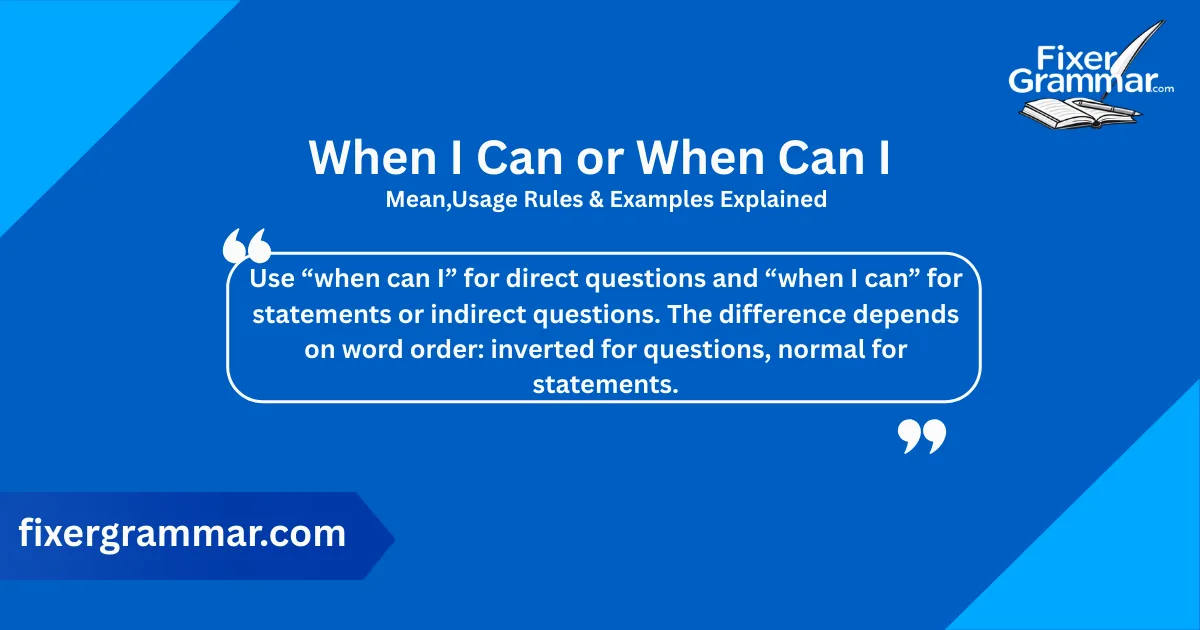
Is it “when I can” or “when can I”? The answer depends on whether you’re asking a question or making ...
Read more
Unregister vs Deregister– Meaning, Usage & Examples

Unregister means something has never been registered or lacks registration status. Deregister means removing something from an existing registry after ...
Read more
Unselect or Deselect – Meaning, Usage & Examples

Deselect is the correct and preferred term in professional writing, technical documentation, and user interface design. While unselect appears in ...
Read more
It’s Called vs It Called– Meaning, Usage & Examples

“It’s called” is the correct form when naming or identifying something in the present tense, while “it called” is grammatically ...
Read more
An Hilarious or A Hilarious – Meaning, Usage & Examples

Wondering whether to say “an hilarious” or “a hilarious”? The correct answer is “a hilarious.” You’ll learn why “a” is ...
Read more
Input or Imput – Meaning, Usage & Examples

“Input” is the only correct spelling. “Imput” is a common misspelling that doesn’t exist in English dictionaries. If you’ve been ...
Read more
Imitated vs Intimated– Meaning, Usage & Examples

Imitated means to copy or mimic someone’s actions, speech, or style . Intimated means to hint or suggest something indirectly ...
Read more
Invision or Envision– Meaning, Usage & Examples

The correct word is envision. The word “invision” is a common spelling mistake that doesn’t exist in English dictionaries. Always ...
Read more
Extensible vs. Extendible – Meaning, Usage & Examples

Extensible describes systems or software that expand through add-ons, plugins, or modules. Extendible is often a misspelling—the correct term is ...
Read more
Who to Contact or Whom to Contact– Meaning, Usage & Examples

Whom to contact is grammatically correct. The word “whom” acts as an object pronoun receiving the action of contacting. However, ...
Read more