In this article, you’ll learn exactly what foolproof means, why “full proof” causes so much confusion, how to tell them apart instantly, and how to never mix them up again.
What Does “Full Proof” Mean?
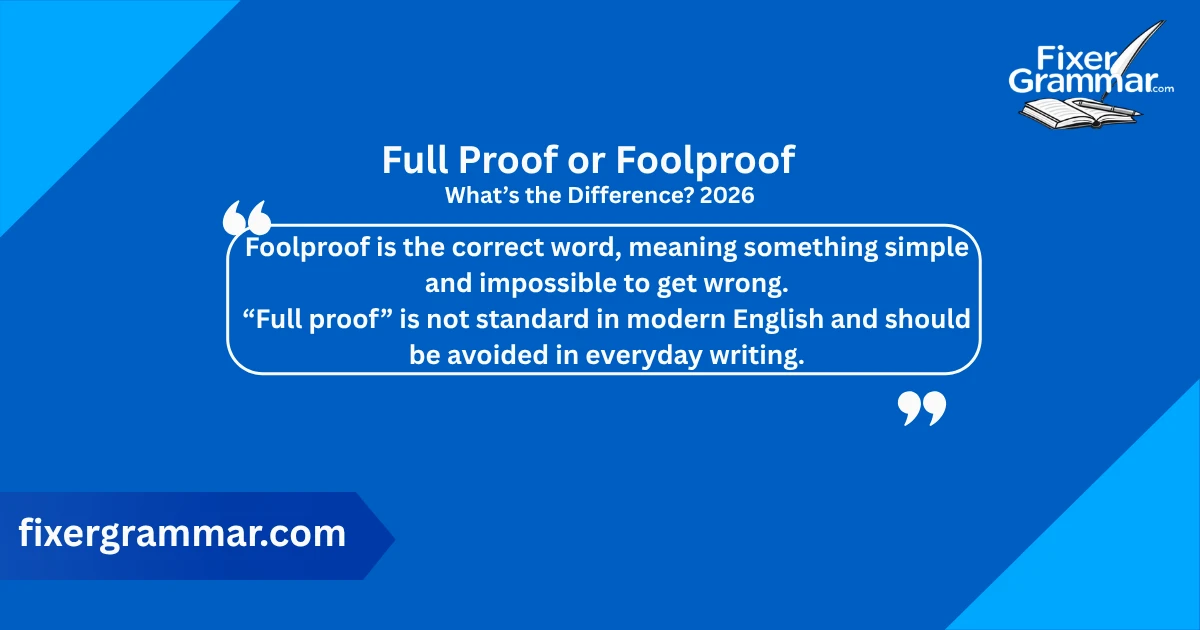
Full proof is not a standard word in modern English. It does not mean “cannot fail” or “perfect.”
Historically, the phrase appeared in two very specific contexts. In 17th and 18th century legal writing, full proof meant conclusive evidence — proof so complete it left no doubt. In distilling and alcohol production, it referred to spirits at full alcohol strength before dilution.
Outside of those narrow uses, full proof has no place in everyday writing.
What Does “Foolproof” Mean?
Foolproof is an adjective. It means something is so simple, well-designed, or reliable that even the most careless person cannot mess it up.
Think of it like waterproof or fireproof. Something waterproof resists water. Something foolproof resists mistakes — even by a fool.
The word entered English in the early 20th century. Engineers and manufacturers used it to describe systems designed to prevent human error. According to Merriam-Webster, foolproof means “leaving no opportunity for error, misuse, or failure.”
Common foolproof example sentences:
- “She created a foolproof system for tracking her expenses.”
- “The recipe is foolproof — even beginners get it right.”
- “His backup plan was foolproof until the power went out.”
Famous author Douglas Adams once wrote: a common mistake when designing something foolproof is underestimating the creativity of complete fools.
More Posts:When I Can or When Can I – Which Is Correct? 2026
Full Proof vs. Foolproof — Key Differences at a Glance
Here is a clear comparison so you can see the difference instantly:
Noun vs Verb (One Word vs Two Words)
| Noun (One Word) | Verb (Two Words) |
|---|---|
| checkup | check up |
| backup | back up |
| setup | set up |
| checkout | check out |
| makeup | make up |
The verdict is simple: In everyday writing, always use foolproof. Full proof belongs only in courtroom history books or whiskey distillery records.
FAQ’s About Full Proof and Foolproof
Is “full proof” ever correct in English?
Only in two very specific contexts — historical legal writing meaning “conclusive evidence,” and alcohol distilling referring to undiluted spirits. In everyday writing, it is always an error.
What is the correct spelling — foolproof or full proof?
Foolproof is the correct spelling. It is one word, no hyphen, no space. “Full proof” and “fullproof” are both misspellings.
What does foolproof mean in simple terms?
It means something is so simple or well-built that nothing can go wrong — even if someone careless is using it.
Is “fullproof” (one word, no space) a real word?
No. Fullproof does not exist in any major dictionary. It is not recognized by Merriam-Webster, Oxford, or Cambridge.
Can I use fool-proof with a hyphen?
The hyphenated form fool-proof is occasionally seen and is not technically wrong, but foolproof as one solid word is the standard, widely accepted spelling.
Why does spellcheck not catch “full proof”?
Because “full” and “proof” are both correctly spelled words on their own. Spellcheck only catches misspelled words — it cannot always detect incorrect word combinations used in the wrong context.
The Bottom Line
Foolproof is the word you want — always. It means reliable, fail-safe, and impossible to get wrong. “Full proof” belongs only in a courtroom from 300 years ago or on a bottle of undiluted whiskey.
The next time you write a foolproof plan, a foolproof method, or a foolproof recipe, you’ll know you have it exactly right. And that knowledge? Completely foolproof.

At FixerGrammar.com, Johnson Isaacs shares easy grammar tips, clear examples, and helpful guidance to make writing simple, smooth, and mistake-free.
Related Posts