This blog will cover what continuous actually means, why so many people misspell it, how it differs from continual, and how to use it correctly in everyday writing.
What Does Continuous Mean? (And What Is Continous?)
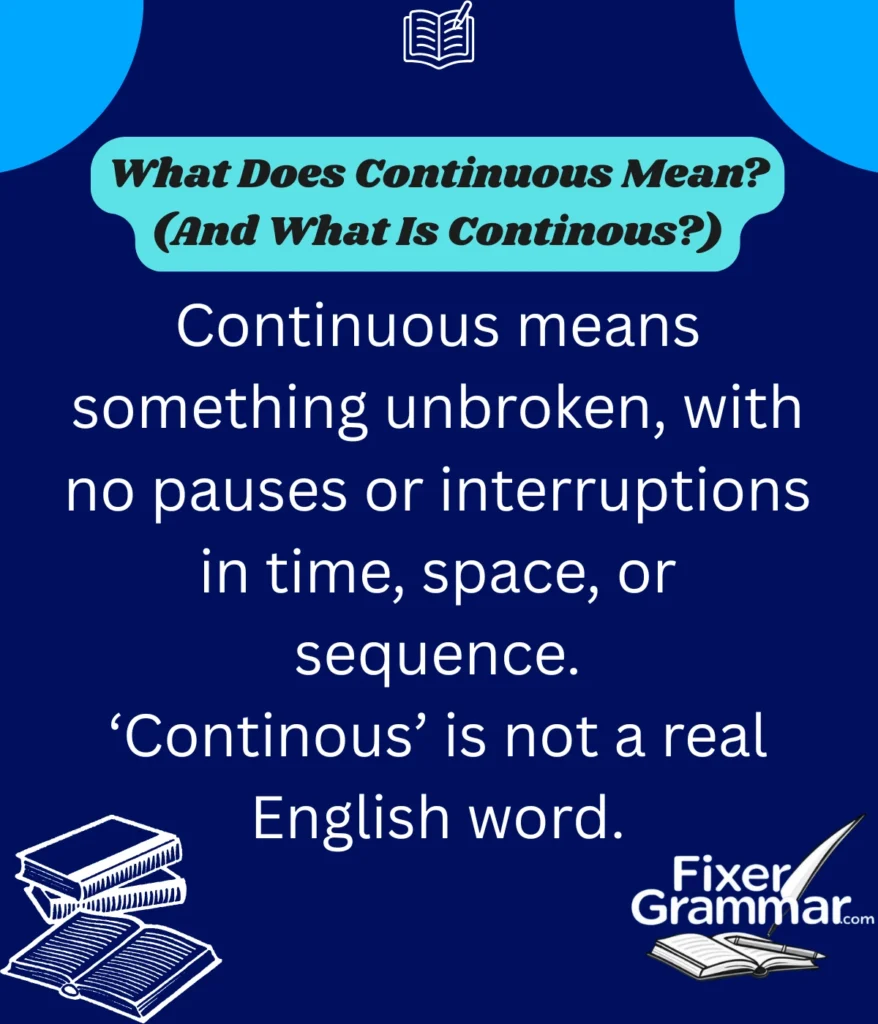
Continuous means something that goes on without any break, pause, or interruption. It describes an unbroken, unceasing flow — in time, space, or sequence.
“Continous” has no definition. It does not exist in the English language. If you have typed it, you meant continuous.
The word traces back to the Latin root continuus, meaning “uninterrupted” or “hanging together.” From that root, English also gave us continuity, continuum, and continue — all sharing the same idea of an unbroken connection.
Common uses of continuous:
- Describing unbroken action: a continuous stream of traffic
- In grammar: the present continuous tense (“She is working”)
- In mathematics: a continuous function has no gaps or jumps in its graph
- In manufacturing: a continuous production line runs without stopping
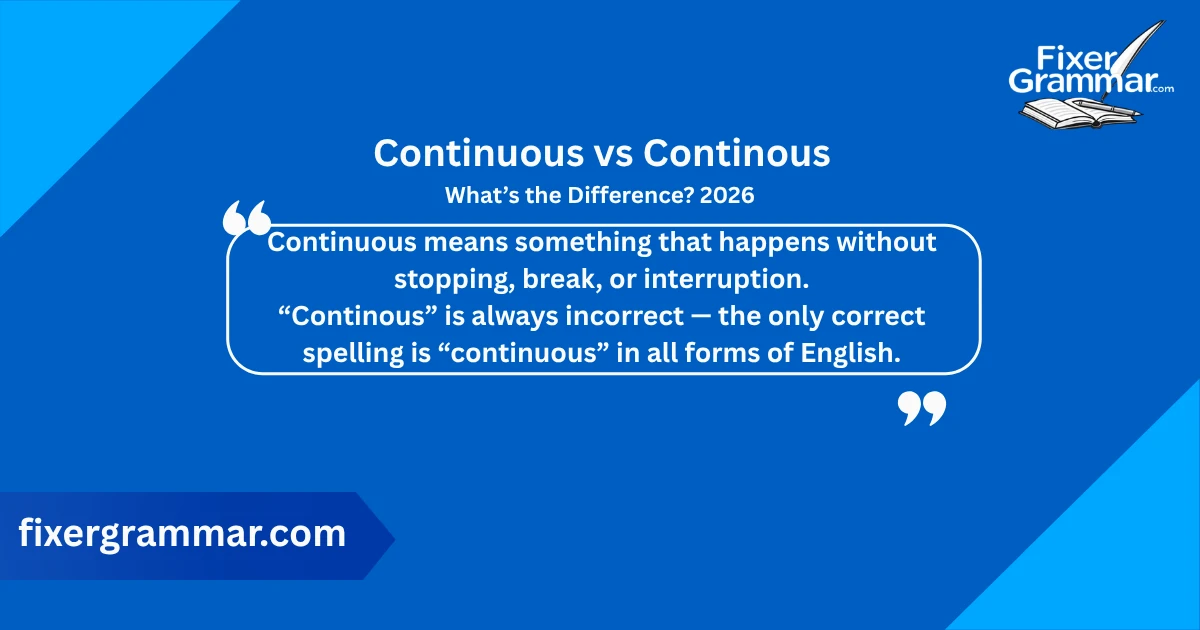
“Continous” is not a real word. The correct spelling is always continuous. No major dictionary — not Merriam-Webster, Oxford, or Cambridge — recognizes “continous” as a valid English word. It is simply a misspelling that happens more often than most people realize.
More Posts:Emasculate vs Demasculate – What’s the Difference? 2026
Continuous vs Continual — The Difference That Trips People Up
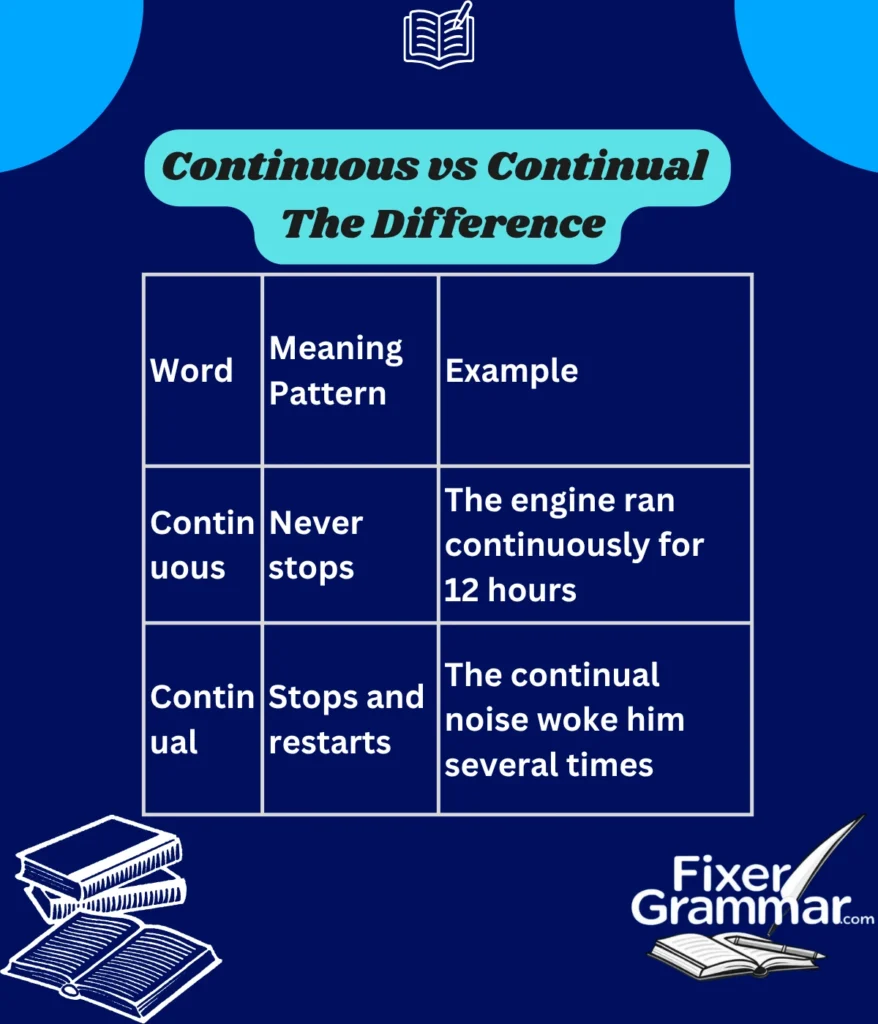
These two words look similar but mean different things. Continuous means something never stops. Continual means something keeps happening but with pauses in between.
Continuous vs Continual
| Word | Pattern | Example |
|---|---|---|
| Continuous | Never stops | The engine ran continuously for 12 hours |
| Continual | Stops and restarts | The continual noise woke him several times |
Think of it this way — a river flows continuously. Rain in spring falls continually — it comes and goes. One never pauses. The other repeats.
Why Do People Spell It “Continous”?
The answer is simple: pronunciation. When we say the word out loud — kən-TIN-yoo-us — that second “u” is very soft. Most people barely hear it.
So when writing quickly, the brain skips it. The result is “continous” instead of “continuous.”
Other common misspellings of continuous:
- Continious — adds an extra “i”
- Continuos — swaps the “u” and “o”
- Continus — drops both the second “u” and “o”
- Coninuous — doubles the wrong letter
Quick memory trick: “Continuous has two U’s — because it keeps going, just like the extra letter.”
Break it down visually: con · tin · u · ous — say it slowly and both U’s are right there.
How to Use Continuous Correctly in a Sentence
Using continuous correctly is straightforward. It describes anything that does not stop or break.
✅ Correct:
- The continuous hum of the air conditioner filled the room.
- She made continuous progress toward her goal.
- The data requires continuous monitoring.
❌ Incorrect:
- The continous hum of the air conditioner filled the room.
- She made continous progress toward her goal.
Synonyms for continuous you can use to vary your writing:
- Uninterrupted
- Unbroken
- Constant
- Perpetual
- Sustained
- Nonstop
- Unceasing
Each carries a slightly different shade of meaning — but all point to the same idea of something ongoing and without a gap.
More Posts:When I Can or When Can I – Which Is Correct? 2026
FAQ’s About Continuous vs Continous
Is “continous” ever correct?
No. “Continous” is always a misspelling. Every major dictionary — Merriam-Webster, Oxford, Cambridge, Collins — flags it as an error. The only correct spelling is continuous.
What is the difference between continuous and continual?
Continuous means something never stops. Continual means something happens repeatedly but with breaks in between. A waterfall flows continuously; a car alarm rings continually through the night.
How do you pronounce continuous?
It is pronounced kən-TIN-yoo-us — four syllables. Saying it slowly helps you hear the second “u” that many people forget when spelling it.
What are synonyms for continuous?
Unbroken, unceasing, perpetual, nonstop, constant, sustained, uninterrupted — all are strong alternatives depending on the context of your sentence.
Can continuous describe a verb tense?
Yes. The present continuous tense describes an ongoing action right now — for example, “I am writing” or “They are working.” It is one of the most-used tenses in everyday English.
Is there a difference between American and British spelling?
No difference here. Both American and British English spell it the same way — continuous. There is no regional variation for this word.
Final Verdict
The answer is clear: continuous is always correct. Continous is always wrong.
Remember the rule — add the suffix -uous to the base word continue, and you keep both U’s. It gives you continuous, every single time.
When in doubt, break the word into syllables: con · tin · u · ous. That second “u” is easy to see — and easy to remember.
Run a quick spell-check before sending any important document. One letter makes the difference between polished writing and a careless error.

At FixerGrammar.com, Johnson Isaacs shares easy grammar tips, clear examples, and helpful guidance to make writing simple, smooth, and mistake-free.
Related Posts