This guide will clear up the confusion and show you exactly when and how to use this Phrase properly.
What Do Alright and All Right Actually Mean?
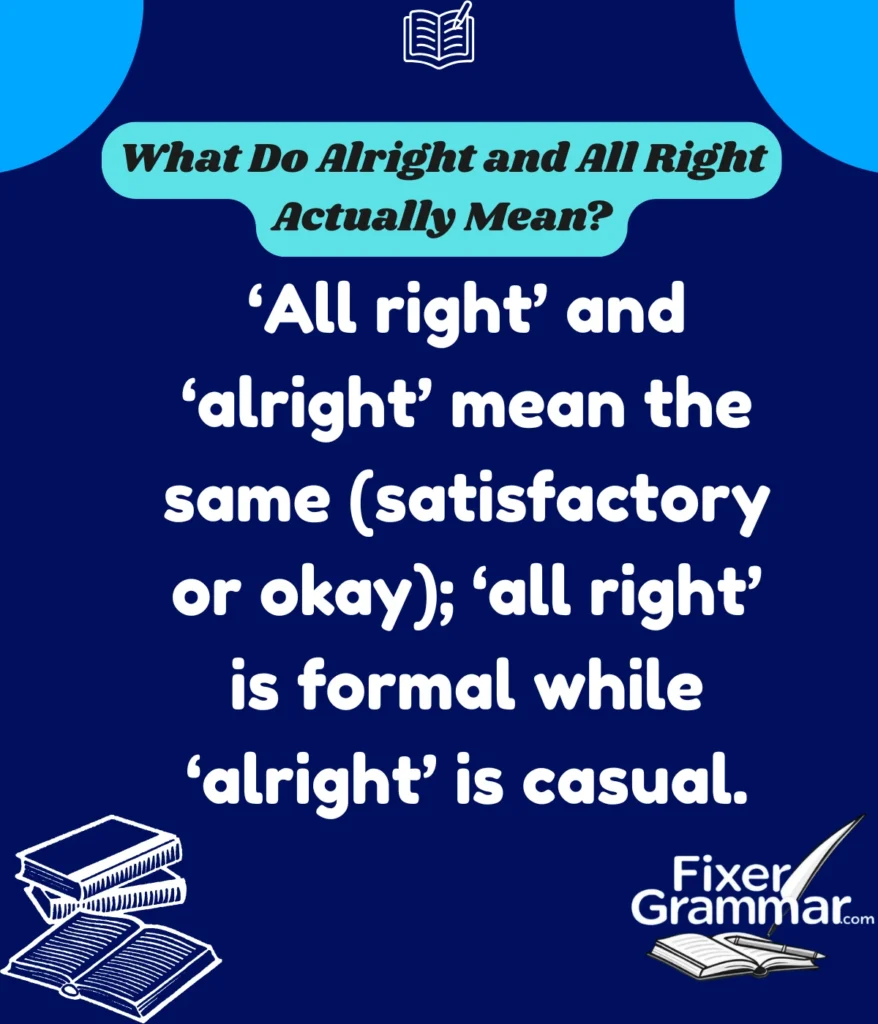
Both words carry the exact same meaning. They work as an adverb, adjective, or exclamation — and neither changes the meaning of your sentence.
“All right” means satisfactory, acceptable, or expressing agreement. “Alright” means the exact same thing — the only real difference is how formal your writing needs to be.
One thing to know immediately: “Allright” (with double L) is never correct. It does not exist in any dictionary. Delete it whenever you see it.
All Right vs Alright – Usage Guide
| Form | Status | Best Used In |
| All right | Standard / Formal | Academic, professional, legal writing |
| Alright | Informal / Casual | Texting, dialogue, creative writing |
| Allright | Incorrect | Never |
Alright — The Informal One
“Alright” has been in print since the 1880s. It feels natural in speech, text messages, and casual conversation. When a character in a novel says “You alright?” — that sounds real and human.
Writers like James Joyce used it. Songs like Kendrick Lamar’s Alright made it iconic. But style guides like the Chicago Manual of Style and the AP Stylebook still flag it as informal and nonstandard.
Key point: “Alright” works great in creative writing and everyday conversation. It just does not belong in formal writing.
All Right — The Formal Standard
“All right” is the version every style guide agrees on. The AP Stylebook, Chicago Manual of Style, Merriam-Webster, and Oxford English Dictionary all list it as the preferred, standard spelling.
Historically, “all” worked as an intensifier meaning completely, and “right” meant correct. Together they meant completely correct — and that two-word form has stayed the standard ever since.
Use “all right” in: academic papers, business emails, legal documents, resumes, and any professional context where your writing will be judged.
More Posts:Unregister vs Deregister– What’s the Difference? 2026
Alright vs All Right — Key Differences at a Glance
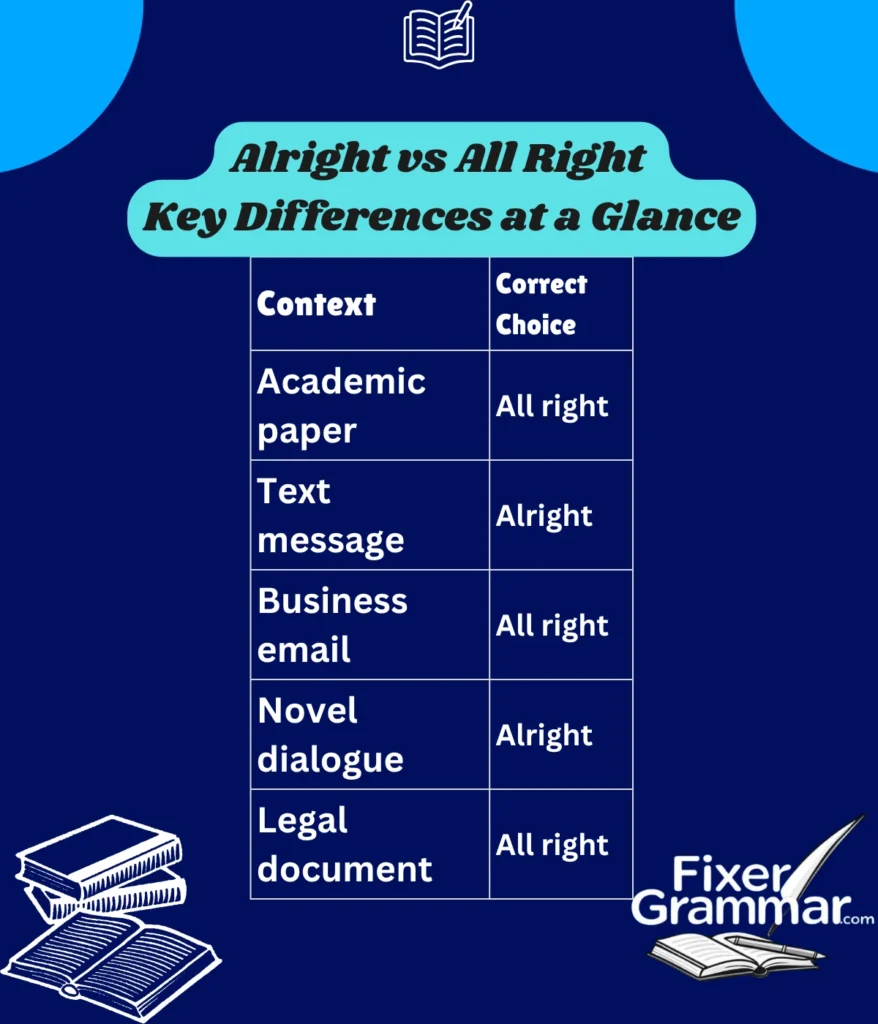
This is where most writers get tripped up. The grammar rule is simple — the context is what changes everything.
Common mistake: Writers who learned “alright is wrong” overcorrect. They write “Are you all right?” in dialogue — and it sounds wooden and unnatural. Both overcorrecting and undercorrecting cause problems.
Memory Aid: FORMAL writes it ALL out. When the writing is formal — spell it ALL out: all right. When it’s casual — alright fits just fine.
All Right vs Alright – Context Usage
| Context | Correct Choice | Example |
| Academic paper | All right | The findings appear all right |
| Text message | Alright | “I’m alright, just tired” |
| Business email | All right | Everything looks all right |
| Novel dialogue | Alright | “You alright?” she asked |
| Legal document | All right | Terms prove all right for both parties |
Real Sentence Examples of Alright vs All Right
Seeing both forms in real sentences makes the rule stick faster than any explanation.
Formal examples — use “all right”:
- The report’s methodology looks all right to the review committee.
- Please confirm the contract terms are all right before signing.
- Her academic performance is all right, though there is room for improvement.
Casual examples — “alright” works here:
- “Yeah, I’m alright — just a long day.”
- “Alright, let’s get started,” he said, pulling out his notes.
- She texted back: “alright see you at 6.”
Wrong usage — and how to fix it:
- ❌ “He did allright on the exam.” → ✅ “He did all right on the exam.”
- ❌ “The are you all right?” in casual teen dialogue → ✅ “You alright?”
More Posts:Company-Wide or Companywide– Which Is Correct? 2026
FAQs About Alright vs All Right
Is “alright” wrong to use?
Not entirely — but it is nonstandard. Stick with “all right” in any formal or professional context to stay safe.
Why do people still prefer “all right”?
Because every major style guide — AP, Chicago, MLA — recommends it. It has been the accepted standard for over a century and carries more professional credibility.
Does “alright” have a different meaning than “all right”?
No. Both carry the identical meaning — satisfactory, fine, or expressing agreement. The difference is purely about formality, not definition.
How can I remember which one to use?
Use this: FORMAL writes it ALL out. Formal writing = all right. Casual writing = alright is fine.
Has usage of alright vs all right changed over time?
Yes. According to Google Ngram Viewer, “alright” has seen a steady rise since the mid-20th century — especially in digital communication. But style guides have not fully embraced it yet.
Is “alright” more common in British English?
Slightly. British style guides are a bit more flexible with “alright” in informal writing — but both varieties still treat “all right” as the formal standard.
Conclusion
Alright vs All Right comes down to one thing — context. Use “all right” whenever your writing is formal, professional, or academic.
Use “alright” in casual conversation, creative dialogue, or texting. And never write “allright” — ever. Know your context, match your spelling, and your writing will always be right.

At FixerGrammar.com, Johnson Isaacs shares easy grammar tips, clear examples, and helpful guidance to make writing simple, smooth, and mistake-free.
Related Posts