This guide will clear up the confusion and show you exactly when and how to use emasculate properly.
Understanding Emasculate–Definition and Proper Usage
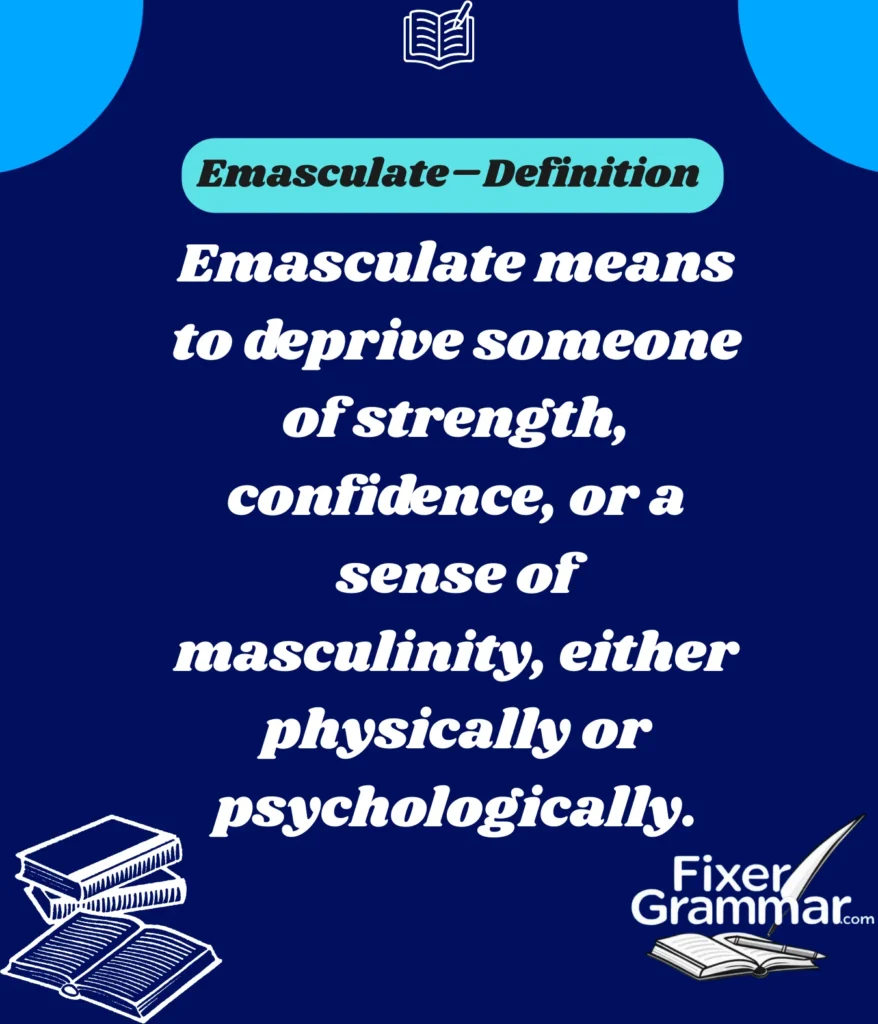
The word emasculate comes from Latin “emasculatus,” meaning to castrate or deprive of masculine vigor. It entered English in the 17th century and has two distinct meanings.
The literal meaning refers to the surgical removal of male reproductive organs. This medical definition is rarely used in everyday conversation but appears in veterinary and medical contexts.
The figurative meaning is far more common. When something emasculates a person, it weakens their power, authority, or confidence. This usage applies to both men and women, despite the word’s masculine roots.
More Posts:Propose vs Purpose: Understanding,Definition And Usage
Verb Forms of Emasculate
| Verb Form | Example |
|---|---|
| Emasculate | “Don’t let criticism emasculate your creativity.” |
| Emasculated | “The edited version emasculated the original message.” |
| Emasculating | “Constant micromanagement is emasculating for employees.” |
Demasculate: Does This Word Actually Exist?
No, demasculate is not a real word. Major dictionaries including Merriam-Webster, Oxford, and Cambridge don’t recognize it as valid English.
Some obscure or historical word lists mention “demasculate,” but it has zero acceptance in modern standard usage.
Why this matters: Spell-checkers flag demasculate as an error. Academic papers, business documents, and published articles never use this term. If you’re writing anything important, stick with emasculate.
The linguistic reality is simple. While English has many “de-” prefix words like “defrost” or “deactivate,” emasculate already contains the meaning of removal or reduction. Adding “de-” creates redundancy that language doesn’t need.
Emasculate vs. Demasculate Key Differences Explained
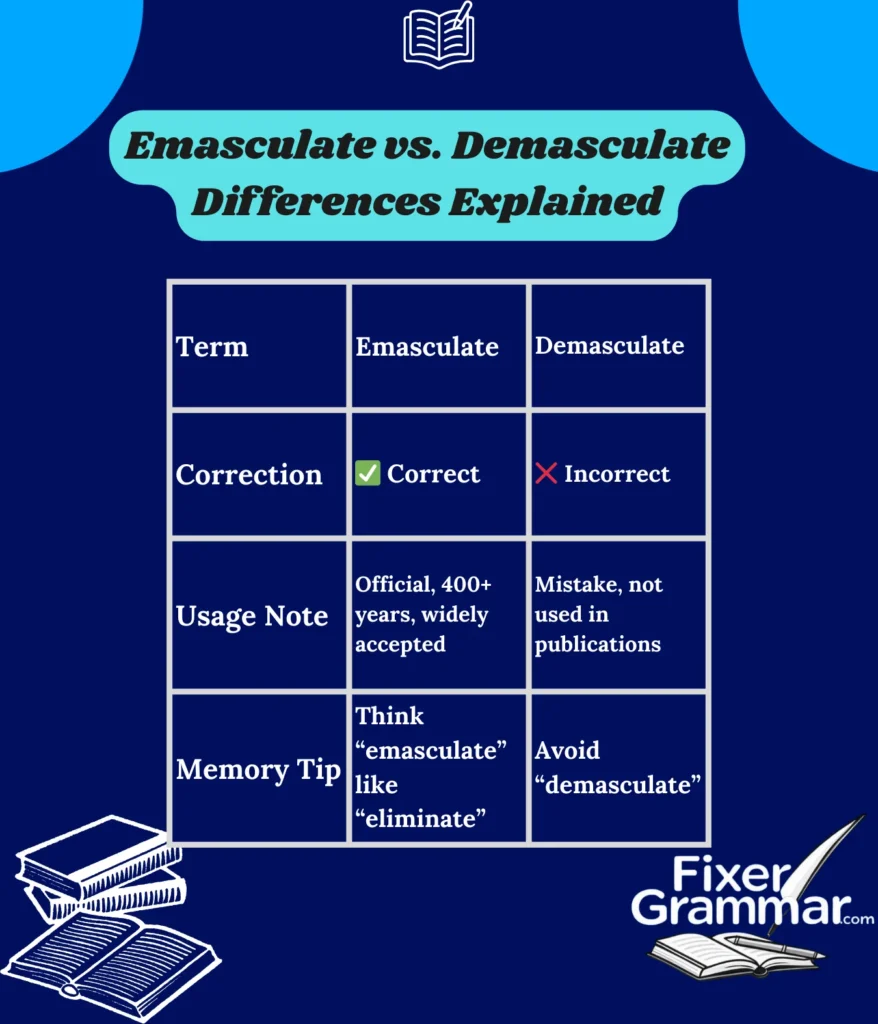
The differences are straightforward because only one option is correct.
Emasculate appears in every major dictionary with clear definitions. It has 400+ years of documented usage in English literature. Professional writers, academics, and editors universally accept it.
Demasculate exists only as a mistake. People create it by incorrectly assuming they need a “de-” prefix. No credible publication uses this word.
- Correct: “The scandal emasculated his political career.”
- Incorrect: “The scandal demasculated his political career.”
Memory trick: Think of emasculate like “eliminate” – both start with “e” and both mean removing something. You don’t say “deliminate,” so don’t say “demasculate.”
More Posts:Time Slot vs Timeslot: Which is Correct, Usage and Common Mistakes
How to Use Emasculate Correctly in Sentences
Social contexts often involve discussions of confidence and personal power. “Constant put-downs can emasculate anyone’s self-esteem” shows the psychological impact.
In professional writing, emasculate describes organizational weakening. According to workplace communication studies, phrases like “budget cuts emasculated the department’s capabilities” appear frequently in business analyses.
Cultural commentary uses emasculate to discuss societal power dynamics. “The policy emasculated local governments’ authority” is a typical political science application.
Here are real-world examples:
- “Excessive regulations emasculate small business innovation.”
- “The director’s vision was emasculated by studio interference.”
- “Fear of failure can emasculate creative risk-taking.”
- “The amendment emasculated the bill’s original intent.”
Common mistake to avoid: Don’t confuse emasculate with “immaculate” (meaning spotless). These sound similar but mean completely different things.
FAQ’s
Is demasculate a real word?
No, demasculate isn’t recognized by standard dictionaries and shouldn’t be used in proper writing.
What does emasculate mean in simple terms?
Emasculate means to weaken, deprive of power, or reduce someone’s strength and confidence.
Can you use demasculate in writing?
Never use demasculate in formal, academic, or professional writing—it’s considered incorrect.
What’s the opposite of emasculate?
The opposite would be empower, strengthen, invigorate, or fortify.
Are emasculate and demasculate interchangeable?
No, because demasculate isn’t a valid word; only emasculate should be used.
When did emasculate enter the English language?
Emasculate entered English around 1623 from Latin roots, meaning to castrate or weaken.
Does emasculate only apply to men?
No, emasculate can describe weakening anyone or anything, regardless of gender.
Final Verdict
Always use emasculate. This is the only grammatically correct, dictionary-approved term. Every major style guide including AP, Chicago, and MLA recognizes only emasculate.
When describing reduced power or strength, emasculate is your word. When discussing weakened authority or confidence, emasculate fits perfectly. When you need to convey diminished effectiveness, emasculate does the job.

At FixerGrammar.com, Johnson Isaacs shares easy grammar tips, clear examples, and helpful guidance to make writing simple, smooth, and mistake-free.
Related Posts